What Are the Signs a Flagpole Needs to Be Reset or Replaced?
A pole that sways at the base or has started to lean usually means the footing has shifted or the ground sleeve has corroded, and every storm makes it worse. Aluminum poles also fatigue near ground level, where moisture collects, so look there for cracks or heavy white pitting, and check whether the truck and pulley up top have seized. Catch it early and you're usually looking at a simple reset, not a pole lying across your driveway.
- Leaning or swaying at the base
- Cracks or pitting near ground level
- Corroded or loose ground sleeve
- Seized truck or pulley
Does a Residential Flagpole Need a Concrete Foundation?
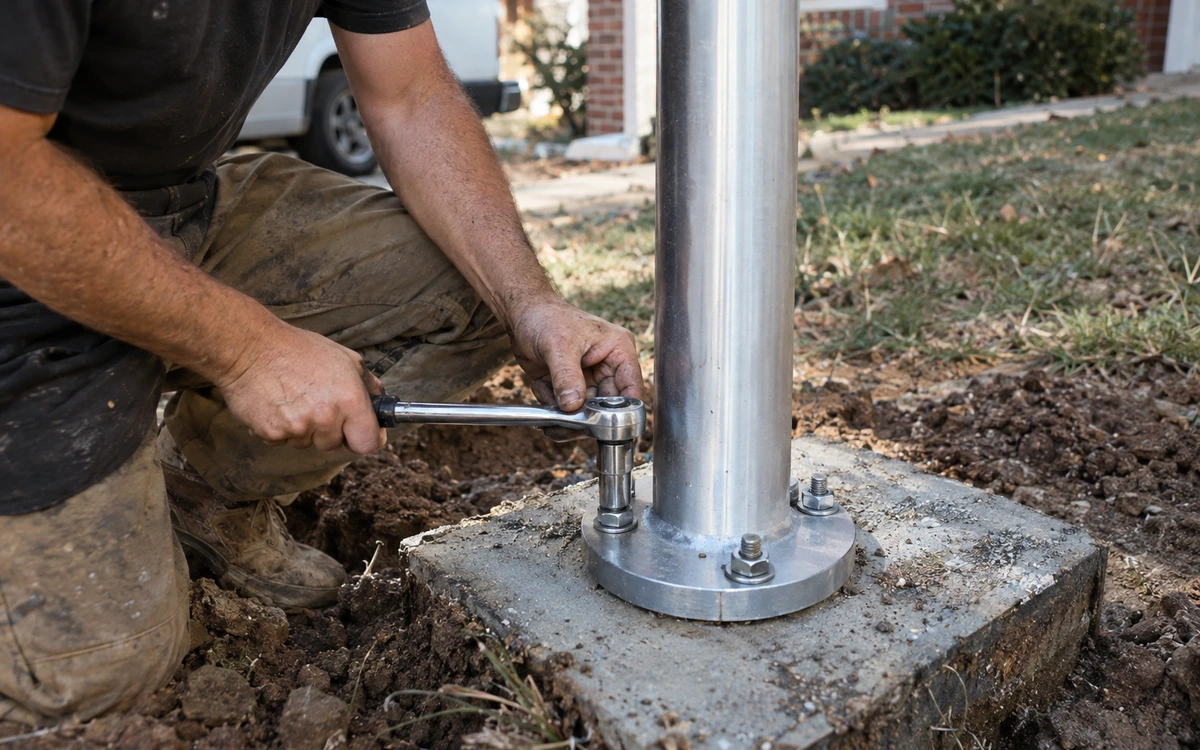
Yes, for any in-ground pole. We auger a hole about 10 percent of the pole's total length deep, a little deeper in frost country, then set a steel or PVC ground sleeve dead plumb in concrete and give it a few days to cure before the pole goes in. The pole rests on sand inside that sleeve, held at the top with hardwood or rubber wedges, so it can be pulled later without breaking up the footing.
Why Is My Flagpole Leaning After a Storm?
Saturated soil and a big flag put serious leverage on the footing, and a hole dug too shallow or too narrow will rotate in the ground. Sometimes the concrete is fine and the wedges have simply loosened, or the sand inside the sleeve has washed out, letting the pole tip within its socket. That's a quick re-plumb and re-wedge. A rotated footing, on the other hand, has to be dug out and repoured.
Is a Telescoping Flagpole as Sturdy as a Sectional Aluminum Pole?
Not in real wind. Telescoping poles are thin-wall tubing locked together with pins or friction collars, and those joints are the first thing to slip or bend in a gusty, open yard. A heavier-wall sectional or one-piece aluminum pole with a proper halyard system rides out storms far better, and on exposed or coastal lots, that's the pole we'd install.
How Much Does Flagpole Installation Cost?
Flagpole installation typically costs $685 to $3,840 for a residential in-ground pole. That price covers augering the hole, pouring the concrete footing, setting the ground sleeve, and the pole itself. Most of the spread comes down to pole height and wall thickness: a 25-foot heavy-wall aluminum pole costs far more than a standard 20-foot one. Rocky soil, footings dug below frost depth, and extras like solar lighting or a locking halyard push the job toward the top of the range.
Our Service Area
We provide services nationwide, including in the following cities:
Alabama
Arizona
- Apache Junction, AZ
- Avondale, AZ
- Casas Adobes, AZ
- Mesa, AZ
- Peoria, AZ
- Phoenix, AZ
- Prescott, AZ
- Rio Rico, AZ
- Tucson, AZ
Arkansas
California
- Alhambra, CA
- Apple Valley, CA
- Bakersfield, CA
- Bell Gardens, CA
- Bellflower, CA
- Bloomington, CA
- Brea, CA
- Brentwood, CA
- Carlsbad, CA
- Chico, CA
- Corona, CA
- Desert Hot Springs, CA
- Dinuba, CA
- Dixon, CA
- Dublin, CA
- East Hemet, CA
- East Niles, CA
- El Centro, CA
- El Cerrito, CA
- Fallbrook, CA
- Foothill Farms, CA
- Fountain Valley, CA
- Fresno, CA
- Glendale, CA
- Highland, CA
- Huntington Beach, CA
- Inglewood, CA
- Lafayette, CA
- Lake Elsinore, CA
- Lakeside, CA
- Lawndale, CA
- Long Beach, CA
- Los Angeles, CA
- Menlo Park, CA
- Mission Viejo, CA
- Montebello, CA
- Moreno Valley, CA
- Norco, CA
- Oakland, CA
- Paramount, CA
- Pleasanton, CA
- Ridgecrest, CA
- Rohnert Park, CA
- Roseville, CA
- Sacramento, CA
- San Diego, CA
- San Francisco, CA
- San Jose, CA
- San Luis Obispo, CA
- San Marcos, CA
- San Pablo, CA
- Santa Rosa, CA
- Saratoga, CA
- South Gate, CA
- Stanton, CA
- Stevenson Ranch, CA
- Sunnyvale, CA
- Thousand Oaks, CA
- Tulare, CA
- Watsonville, CA
- West Puente Valley, CA
- West Sacramento, CA
- Westmont, CA
- Windsor, CA
- Yuba City, CA
- Yucca Valley, CA
Colorado
- Aurora, CO
- Broomfield, CO
- Centennial, CO
- Colorado Springs, CO
- Columbine, CO
- Denver, CO
- Firestone, CO
- Grand Junction, CO
- Littleton, CO
- Northglenn, CO
- Pueblo, CO
Connecticut
- Branford, CT
- Cheshire, CT
- Groton, CT
- Manchester, CT
- New Canaan, CT
- New Haven, CT
- Ridgefield, CT
- Southbury, CT
- Wallingford, CT
- Watertown, CT
District of Columbia
Florida
- Biscayne Gardens, FL
- Bloomingdale, FL
- Boca Raton, FL
- Brandon, FL
- Carrollwood, FL
- Clermont, FL
- Coral Springs, FL
- Country Club, FL
- Cutler Bay, FL
- Fleming Island, FL
- Florida Ridge, FL
- Four Corners, FL
- Gainesville, FL
- Groveland, FL
- Holiday, FL
- Homestead, FL
- Hunters Creek, FL
- Jacksonville, FL
- Largo, FL
- Lehigh Acres, FL
- Marion Oaks, FL
- Melbourne, FL
- Miami, FL
- Naples, FL
- Ormond Beach, FL
- Palmetto Bay, FL
- Panama City, FL
- Parkland, FL
- Plant City, FL
- Riviera Beach, FL
- Ruskin, FL
- St. Cloud, FL
- Tamarac, FL
- Tampa, FL
- Temple Terrace, FL
- Titusville, FL
- Winter Park, FL
- Wright, FL
Georgia
- Acworth, GA
- Albany, GA
- Alpharetta, GA
- Atlanta, GA
- Canton, GA
- Cartersville, GA
- Douglasville, GA
- Fayetteville, GA
- LaGrange, GA
- Marietta, GA
- McDonough, GA
- Savannah, GA
- St. Marys, GA
Hawaii
Idaho
Illinois
- Blue Island, IL
- Buffalo Grove, IL
- Carol Stream, IL
- Chicago, IL
- Decatur, IL
- Edwardsville, IL
- Hanover Park, IL
- Kankakee, IL
- Lake in the Hills, IL
- Maywood, IL
- Naperville, IL
- Normal, IL
- Northbrook, IL
- O'Fallon, IL
- Oak Lawn, IL
- Oak Park, IL
- South Holland, IL
- Vernon Hills, IL
- Westmont, IL
Indiana
- Clarksville, IN
- East Chicago, IN
- Fort Wayne, IN
- Greenfield, IN
- Greenwood, IN
- Hammond, IN
- Hobart, IN
- Indianapolis, IN
- Marion, IN
- Michigan City, IN
- Muncie, IN
- New Albany, IN
Iowa
Kansas
Kentucky
Louisiana
Maine
Maryland
- Ballenger Creek, MD
- Baltimore, MD
- Bel Air North, MD
- Bel Air South, MD
- Clinton, MD
- Cockeysville, MD
- Dundalk, MD
- North Potomac, MD
- Owings Mills, MD
- Potomac, MD
- Silver Spring, MD
Massachusetts
- Acton, MA
- Belmont, MA
- Boston, MA
- Cambridge, MA
- Chelmsford, MA
- Grafton, MA
- Marlborough, MA
- Medford, MA
- Milton, MA
- New Bedford, MA
- North Andover, MA
- North Attleborough, MA
- Plymouth, MA
- Reading, MA
- Somerville, MA
- Stoneham, MA
- Watertown, MA
- West Springfield, MA
- Westfield, MA
Michigan
- Adrian, MI
- Delta, MI
- Detroit, MI
- Farmington Hills, MI
- Forest Hills, MI
- Hamburg, MI
- Highland, MI
- Lansing, MI
- Meridian, MI
- Novi, MI
- Orion, MI
- Pittsfield, MI
- Plymouth Township, MI
- Romulus, MI
- Sterling Heights, MI
- Summit, MI
- Taylor, MI
- Walker, MI
- Washington, MI
Minnesota
- Champlin, MN
- Elk River, MN
- Fridley, MN
- Maple Grove, MN
- Minneapolis, MN
- Minnetonka, MN
- Moorhead, MN
- New Brighton, MN
- Owatonna, MN
- Roseville, MN
- South St. Paul, MN
- Woodbury, MN
Mississippi
Missouri
Montana
Nebraska
Nevada
New Hampshire
New Jersey
- Cherry Hill, NJ
- Cliffside Park, NJ
- East Brunswick, NJ
- East Windsor, NJ
- Galloway, NJ
- Garfield, NJ
- Jackson, NJ
- Jefferson, NJ
- Jersey City, NJ
- Little Egg Harbor, NJ
- Maple Shade, NJ
- Neptune, NJ
- Old Bridge, NJ
- Parsippany-Troy Hills, NJ
- Roselle, NJ
- Somerset, NJ
- South Plainfield, NJ
- Toms River, NJ
- Union, NJ
- Washington Township, NJ
- Winslow, NJ
New Mexico
New York
- Baldwin, NY
- Brighton, NY
- DeWitt, NY
- East Meadow, NY
- East Patchogue, NY
- Haverstraw, NY
- Irondequoit, NY
- Kiryas Joel, NY
- Monroe, NY
- Montgomery, NY
- Mount Pleasant, NY
- New Rochelle, NY
- New York, NY
- Newburgh, NY
- North Bay Shore, NY
- Oceanside, NY
- Ossining, NY
- Peekskill, NY
- Pittsford, NY
- Port Chester, NY
- Poughkeepsie, NY
- Queensbury, NY
- Rochester, NY
- Selden, NY
- Utica, NY
- West Babylon, NY
- West Seneca, NY
North Carolina
- Charlotte, NC
- Fuquay-Varina, NC
- Huntersville, NC
- Indian Trail, NC
- Kernersville, NC
- Knightdale, NC
- Raleigh, NC
- Statesville, NC
- Wake Forest, NC
- Winston-Salem, NC
North Dakota
Ohio
- Cleveland, OH
- Columbus, OH
- Elyria, OH
- Findlay, OH
- Lancaster, OH
- Lima, OH
- Mansfield, OH
- Maple Heights, OH
- Newark, OH
- North Royalton, OH
- Perrysburg, OH
- Piqua, OH
- Riverside, OH
- Troy, OH
Oklahoma
Oregon
Pennsylvania
- Bensalem, PA
- Coolbaugh, PA
- Cranberry, PA
- East Pennsboro, PA
- Lancaster, PA
- Palmer, PA
- Philadelphia, PA
- Plum, PA
- Ridley, PA
- Spring, PA
- Springettsbury, PA
- Upper Merion, PA
- Upper Moreland, PA
- Upper Providence, PA
- Warminster, PA
- Warrington, PA
- Whitehall Township, PA
- Wilkes-Barre, PA
- Williamsport, PA
Rhode Island
South Carolina
South Dakota
Tennessee
Texas
- Arlington, TX
- Austin, TX
- Bedford, TX
- Belton, TX
- Benbrook, TX
- Channelview, TX
- College Station, TX
- Converse, TX
- Dallas, TX
- Deer Park, TX
- Denton, TX
- Dickinson, TX
- Duncanville, TX
- El Paso, TX
- Fort Worth, TX
- Harlingen, TX
- Houston, TX
- Kyle, TX
- League City, TX
- Lubbock, TX
- Lufkin, TX
- Marshall, TX
- Melissa, TX
- Midlothian, TX
- Richardson, TX
- Rockwall, TX
- San Antonio, TX
- Seguin, TX
- Spring, TX
- Terrell, TX
- Weatherford, TX
- Weslaco, TX
- Wichita Falls, TX
Utah
Virginia
- Dale City, VA
- Fredericksburg, VA
- Herndon, VA
- Leesburg, VA
- Merrifield, VA
- Montclair, VA
- Norfolk, VA
- Roanoke, VA
- Short Pump, VA
- South Riding, VA
- Virginia Beach, VA
- Waynesboro, VA
Washington
- Edmonds, WA
- Everett, WA
- Kirkland, WA
- Longview, WA
- Mountlake Terrace, WA
- Mukilteo, WA
- Oak Harbor, WA
- Parkland, WA
- Pasco, WA
- Pullman, WA
- Sammamish, WA
- Seattle, WA
- Silver Firs, WA
West Virginia
Wisconsin
- Eau Claire, WI
- Germantown, WI
- Menomonee Falls, WI
- Milwaukee, WI
- Mount Pleasant, WI
- Onalaska, WI
- Superior, WI
- Waukesha, WI
- Wausau, WI