
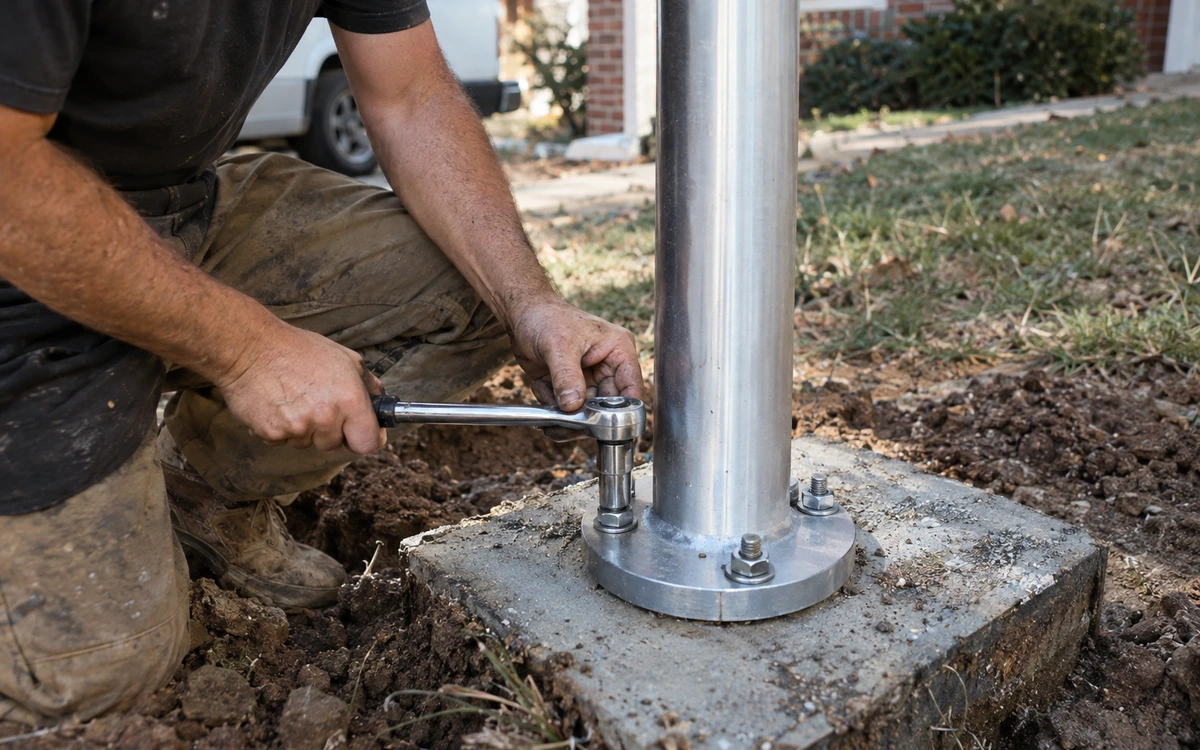
What Are the Signs a Flagpole Needs to Be Reset or Replaced?
A pole that sways at the base or has started to lean usually means the footing has shifted or the ground sleeve has corroded, and every storm makes it worse. Aluminum poles also fatigue near ground level, where moisture collects, so look there for cracks or heavy white pitting, and check whether the truck and pulley up top have seized. Catch it early and you're usually looking at a simple reset, not a pole lying across your driveway.
- Leaning or swaying at the base
- Cracks or pitting near ground level
- Corroded or loose ground sleeve
- Seized truck or pulley
Does a Residential Flagpole Need a Concrete Foundation?
Yes, for any in-ground pole. We auger a hole about 10 percent of the pole's total length deep, a little deeper in frost country, then set a steel or PVC ground sleeve dead plumb in concrete and give it a few days to cure before the pole goes in. The pole rests on sand inside that sleeve, held at the top with hardwood or rubber wedges, so it can be pulled later without breaking up the footing.
Why Is My Flagpole Leaning After a Storm?
Saturated soil and a big flag put serious leverage on the footing, and a hole dug too shallow or too narrow will rotate in the ground. Sometimes the concrete is fine and the wedges have simply loosened, or the sand inside the sleeve has washed out, letting the pole tip within its socket. That's a quick re-plumb and re-wedge. A rotated footing, on the other hand, has to be dug out and repoured.
Is a Telescoping Flagpole as Sturdy as a Sectional Aluminum Pole?
Not in real wind. Telescoping poles are thin-wall tubing locked together with pins or friction collars, and those joints are the first thing to slip or bend in a gusty, open yard. A heavier-wall sectional or one-piece aluminum pole with a proper halyard system rides out storms far better, and on exposed or coastal lots, that's the pole we'd install.
How Much Does Flagpole Installation Cost in Elyria, OH?
Flagpole installation in Elyria, OH typically costs $657 to $3,686 for a residential in-ground pole. That price covers augering the hole, pouring the concrete footing, setting the ground sleeve, and the pole itself. Most of the spread comes down to pole height and wall thickness: a 25-foot heavy-wall aluminum pole costs far more than a standard 20-foot one. Rocky soil, footings dug below frost depth, and extras like solar lighting or a locking halyard push the job toward the top of the range.